Copium on Ice
What Milano Cortina revealed about Canada’s competence problem


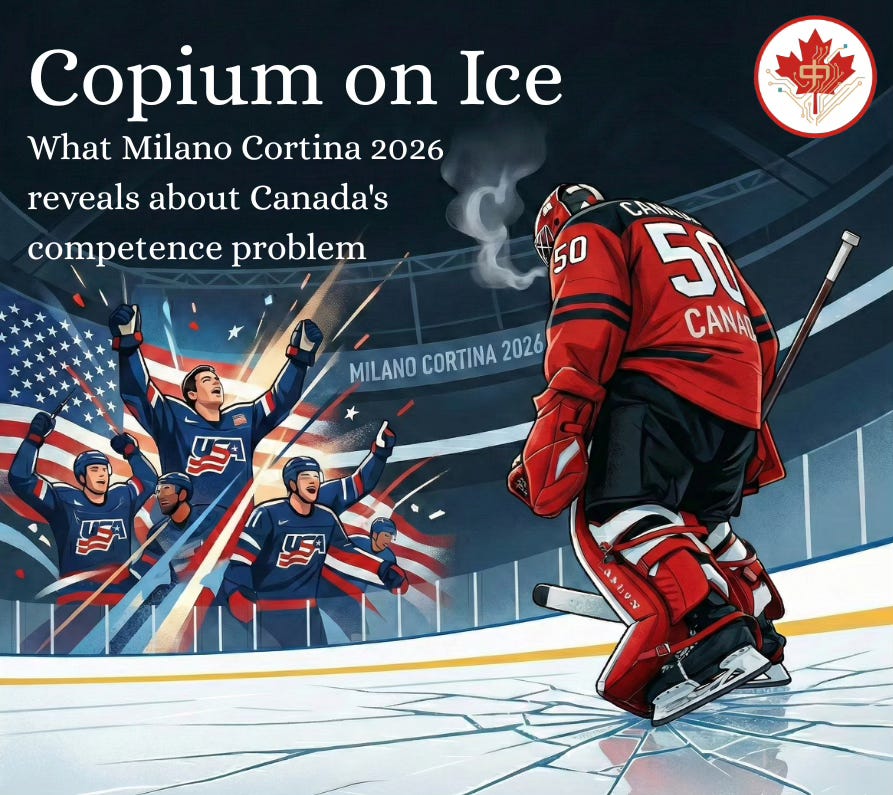
I must say, this is a bit of a strange place to start my substack, but alas, I am someone who often needs a large dose of external motivation to do things. What can I say – pain is a great motivator.
For context, I recently returned from a live watch party with a group of Canadians who live in the Washington DC area, where we watched our cherished national team fall to Team USA in a tournament that probably introduced an entire generation of Canadians to hypertension. Jack Hughes (who has sat injured on my fantasy hockey team for 2 months - what a bum) snipes the puck past Jordan Binnington in 3-on-3 overtime (a crime in a gold medal game) prompting a rather rambunctious “USA USA” chant to the tune of Free Bird’s instrumental climax. This also included sprinkles of goading and “51st state” jeers at the Canadian corner.
Trash talking is common at high-stakes sports games. However, it was rather disheartening hearing the attacks on Canadian sovereignty in a city filled with policy shops and public servants, in one of the “most educated” counties in the U.S. no less. Given the current state of the macro environment, these landed with a lingering sting.
Despite the title, this isn’t really a post about hockey. I believe hockey is just the most visible place where Canada’s broader competence and sovereignty problems leak into public life.
Losing games to the Soviets during the Cold War was also painful, but that was a clash of distinct systems where Canada didn’t stand alone; the USSR was seen as the antithesis of the North American way of life. Losing to the Americans in 2026 is felt more deeply as it sparks an identity crisis. The U.S. has long been our yardstick. It makes sense, after all: it is an inescapable gravitational well of economic dynamism, the political spotlight of the western hemisphere, and the world’s sole military superpower. Watching them dismantle our claim to ice hockey felt like watching your arrogant, rich sibling, the one who is already more successful at almost everything else, beat you at your own game, the only visible thing you could still have claimed you were the best at on the world stage.
It is easy to wave this off. Many Canadians will look at that 2-1 overtime loss and say, “eh it was close, we played better, we would have won a 7 game series,” or “I don’t even care about hockey, there’s more to life and identity than a sport.” When asked “what is Canada?”, they may point to our bilingualism, our friendly image on the world stage, our healthcare system, or our “accepting multicultural culture” as the true markers of the Canadian project. But I argue that these are too abstract; many OECD countries possess these markers, some do them better than Canada. Upon further introspection, uniquely Canadian cultural markers that consistently exist within our national “psyche” seem few and far between. Maple syrup? Beavers? Poutine? (If someone says Drake I will crash out). Canada obviously has many identities. The point is that very few are shared nationally, and even fewer are instantly understood abroad. When one starts pondering the question, it is hard not to think of hockey within the first 10 seconds.
You don’t need to love the sport for it to be an integral part of the national psyche. After all, international competitions are one of the last mass rituals where the subdivisions of a nation are dimmed to compete in a measured way against other countries; where “we” and “they” come with uniforms, medal tables, and a scoreboard. Social psychologists and political scientists called this banal nationalism: everyday symbols that subconsciously remind citizens of their statehood and sovereignty; nations only feel real because shared stories and rituals let strangers imagine themselves as a community.
Hockey permeates Canadian society at many levels. It shows up in the background of commercials, school conversations, parliament debates, national broadcasting moments, donor galas, small-town arenas, and immigration “becoming Canadian” narratives. Even if a significant portion of the population has never played, or followed the sport closely, it is nevertheless an ambient presence in the Canadian way of life, a glue that binds the very conception of “Canada.” And on the world stage, it is one of the rare arenas where Canadians still expect to look unmistakably world-class. It is a highly visible, global signal that the world understood: hockey is Canada’s sport.
National champions
In an age where nations increasingly project power through a multitude of channels – economic, political, cultural – hard and visible symbols increase in importance. Many of the middle powers that Canada frequently compares itself to possess globally dominant “national champions” or economic niches that are easy to point at: the Netherlands has ASML; South Korea has its chaebols; Australia enjoys world-leading mining niches; Taiwan has TSMC...
Whilst this is admittedly a simplistic view of a very nuanced issue, it is also true that Canada’s stake in visible and future industries has been shrinking over the past two decades. We have strengths, but many of them are either invisible, contested, or curiously hard to translate into national identity without American validation. We do not occupy a meaningful and visible stake in global supply chain nodes. Our military has atrophied from decades of under-investment and reliance on the U.S., and our most high-profile cultural stars inevitably migrate south for the US market’s resources and validation, blending into the globalizing force of “Americana”–arguably the most successful example of symbols and soft power in history. Furthermore, many of the OECD Eurasian middle powers we often benchmark against enjoy the additional “glue” from centuries of shared histories, cultural artifacts, and linguistic unity that Canada, being a sprawling immigrant nation, inherently lacks.
Thus, many of our comparative advantages are either:
Not “future-facing,” with a minimal stake in frontier fields like AI (outside of research and talent cultivation, we fail at retention and application), biotech, autonomous/new energy transportation…
Experienced by the common citizen as extractive or oligopolistic rather than dynamic and generative (natural resources, real estate, telecom, banking…).
Culturally validated only after the U.S. market stamps them as real (artists, actors, musicians, authors).
Despite what Prime Minister Carney touted during his Davos address, and despite suffering from the same cost of living malaise as many high-income countries, Canada simply lacks the scale and dynamism that many others possess. Even the most flattering macroeconomic reports have described a competitiveness problem. RBC estimates the Canada-U.S. productivity gap at about $20,000 per person per year. This has significant carry-on effects further down the economy, depressing wages, enterprise profits, government tax revenue, and overall limits the country’s geostrategic room to maneuver. The Bank of Canada has directly stated that weak productivity has persisted for decades, across almost all sectors, and isn’t explained away by industrial structure or “being a small country”. The OECD’s Canada survey frames the same basic concern: per-capita growth is weak because productivity is weak.
If you fed C-suites and investors from Singapore to London half a dozen shots of Crown Royal, and asked them what they thought of the Canadian economy, they will likely say something like “it’s a pylon propped up by real estate valuations and extractive industries” (Business Council of Canada & Canadian Chamber of Commerce have articulated these risks in more diplomatic language).
When a country’s future-facing competence signals feel blurry to the population, they often cling harder to the signals that do remain globally visible. Because we lack world-beating industrial and technological totems or diplomatic heft on the world stage (barring the occasional flashes such as Prime Minister Carney’s Davos speech), our Olympic hockey teams were forced to carry an impossible burden. They were our national champions. One that appears every 4 years where Canadians from Halifax to Whitehorse could point to the ice and say, without caveat: we dominate this. Thus, Canada’s hockey teams have been the cleanest, most universally understood competence signals available. Not the only one. But one that is (a) emotionally central at home and (b) instantly legible abroad.
The Goalie in the Coal Mine
I’d like to explicitly state now that an overtime game does not “prove” a national decline by itself. But to me it is yet another datapoint within a long trend line, which has been flashing warnings for years. The Olympic loss forces another question: is Canada’s hockey pipeline still structurally built for excellence, or is it increasingly built for nostalgia – something PM Carney explicitly stated in Davos as “not a strategy”.
The ice is already cracking, as evidenced by our recent losses in both the men’s and women’s Olympic events. The shortcomings we witnessed in Milan are intricately linked to similar structural failures dragging down the broader Canadian state.
At the grassroots level, The Financial Times reports average annual costs over C$4,400 per child, when you factor in ice time, privatized coaching, and travel, the average cumulative cost of competitive youth hockey scales aggressively past $50,000 CAD by the time their kid reaches 16 and becomes more expensive as one gets older. And the trend line on participation has been worrying for years: AP reports Canadian under-18 participation falling from about 523,000 (2010) to ~412,000 (2022), with a partial rebound to ~437,000 (2023).
Meanwhile, USA Hockey’s base has been expanding: 577,864 players and 676,433 total members in 2024–25, up steadily from the pandemic-era low. Their 2024–25 registration report also shows 396,525 youth players, growing at a rate that will overtake Canada’s sooner rather than later. This is compounded by the U.S. scale advantage. Ceteris paribus–elite talent is a probabilistic numbers game.
If you want an early warning indicator for the health of a national ecosystem, look at Canadian goaltending.
Goaltending is the most capital-intensive, coaching-dependent, and specialized position in hockey. It punishes countries that let the middle of their economic pyramid thin out. Canada was sunk in Milan by a lack of elite goaltending depth, and this isn’t a fluke. Hellebuyck out-dueled Binnington in part because the American goalie system has produced better goalies for the past 10 years. Canadian representation among NHL goaltenders has plummeted from over 60% in the 1990s to 27.2% today. In fact there are currently more American than Canadian goalies in the NHL. Like the decline in competitive industries, we complacently treated hockey like an inherited birthright, whilst everyday families were left to absorb a cost-of-living crisis that made hockey costs feel increasingly like a luxury they couldn’t justify. The U.S., in the same amount of time, successfully created talent pipelines and facilities that nurtured the current gold-medal iteration of Team USA. It utilized the deeper pockets of its upper middle class, alongside the scale of the NCAA and a well-run National Team Development Program, to systemize elite pathways. If the goalie pipeline is thinning relative to peers, it’s a warning siren about who can still afford the most specialized forms of excellence in Canada.
On the bright side, Hockey Canada reports 30% growth in women and girls’ registrations since 2022, signaling sustained grassroots momentum. Despite this surge in Canadian passion, the U.S. side possesses a far more developed, heavily-funded sporting ecosystem for girls and young women through their high school and Title IX-backed college systems. Thus, the U.S. NCAA machine absorbed or out-produced our talent, leading the U.S. women’s national team to match their counterparts and capture gold in Milan at an even quicker pace having won 8 straight vs. Canada in their most recent meetings – a stat-line that indicates systemic advantages rather than a temporary leap in team USA talent levels.
Many news outlets have also echoed why the result feels less like a fluke and more like a structural omen. Canada’s advantage used to be overwhelming participation plus cultural obsession. But now the U.S. can compensate with population scale, deeper funding pools, and institution-building, without ever needing Canada’s level of national fixation – hockey is the 5th most popular sport in the U.S. This trajectory bodes badly for our future Olympic prospects.
The Brain Drain, on Ice
Once a sport becomes pay-to-play at scale, the talent pipeline starts behaving like an economic system where capital and talent inevitably flow toward efficiency. In 2024, the NCAA opened the door to Canadian Hockey League (CHL) players becoming eligible for Division I college hockey beginning in 2025–26. By late 2025, some observers were already describing the rule change as a structural redistribution of talent and leverage across North American hockey development.
The U.S. can now offer a combined package that Canadian systems struggle to match: elite facilities, a powerful university brand, and a lot more money. Following these eligibility rule changes, elite Canadian teenagers are actively abandoning our domestic junior leagues for the heavily-resourced American NCAA. The talent isn’t disappearing from Canada, but it’s increasingly developing inside the American system. CHL grads now account for nearly half of top-25 NCAA recruiting classes, meaning Canada is producing the raw material for an American institution to polish and brand (similar to other aspects of the U.S.-Canada relationship such as resources…). This can reduce the overall talent level and funding for the CHL and the grassroots “hockey economy” in Canada over time if top talent leave once they hit college age.
This closely mirrors our macroeconomic brain drain. Retention of Canadian graduates from top-tier universities sits at 59%. Those who have the opportunity to work for U.S. companies that offer significantly higher compensation will jump at the opportunity - as many of my peers have. Just as our elite hockey prospects migrate south for superior institutional infrastructure, our graduates flee for the U.S. market, driving a positive feedback loop in the aforementioned productivity gap.
Whether you are an 18-year-old goalie or a 23-year-old software engineer, the incentive structure is strikingly similar: Canada produces the talent, then struggles to retain it against American scale, funding, and institutional gravity. This is tough to counteract, and can warrant a 100-page policy document but having more stakeholders recognize the issue is a good place to start.
A Serious Country
To me this is why the “51st state” chants in DC stung. They were a crude articulation of a subtle, more unsettling reality: in a world where “might makes right” overtakes the rules-based order – a country that lacks distinct, visible sovereign capabilities will see its sovereignty treated increasingly as optional.
For decades, we used hockey as “copium”. We used it to manage the anxiety of living in a superpower’s gravitational field. More international parity in hockey is not bad, it makes for more competitive and exciting games. The discomfort Canadians are feeling is because we have suddenly lost the only arena where we held a unique claim to excellence, but more importantly, to a country that, whether intentionally or unintentionally, often treats us like a tributary state.
Prime Minister Carney’s actions appear to recognize this; he framed middle powers as needing to build strength at home in a world where the old order isn’t coming back. His government recently announced a $6.6 billion domestic defense industrial strategy, explicitly aimed at establishing new “sovereign capabilities” by mandating a 70% domestic procurement target. Over the past year Canada has been far more proactive in its diplomatic efforts in previously neglected areas such as Southeast Asia, the Middle East, and South Asia, it is a long overdue, necessary acknowledgment that the era of passive policymaking and lack of visionary leadership must end. The recent multibillion natural resources deal with India is the kind of capability-backed economic diversification Canada needs to bolster existing comparative advantages, such as uranium mining, and diversify trade relations.
My rambling appears to have arrived at some conclusions:
First, the “rally around the flag” effect from the Trump administration’s rhetoric only provides a short-term boost. In a post rules-based world order, Canada needs to use this momentum to build a more robust set of symbols, values, and comparative advantages that persists post-2028. We cannot continue to lean on hockey as a symbolic crutch to cope with our irrelevance elsewhere. Further introspection is needed; a more honest debate must be had about what it means to be “Canadian” that is distinct from using “non-American-ness” as our primary yardstick.
Second, the risks facing Canadian hockey are primarily structural. The cost of living is a root issue. Tackling this is the best path towards getting everyday Canadian families playing hockey again. Furthermore, creating a more inclusive environment at the school-level for girls, non-white, and LGBTQ populations will go a long way to gaining buy-in from the fastest-growing subset of our demography, and diluting the often problematic bro-culture that permeates the sport.
Finally, Canada cannot “out-America” America, and it shouldn’t try. But we also cannot survive by defining ourselves purely by negation, by simply being “not them.” If we want to be taken seriously by the U.S. and beyond, we have to behave like a serious country.
Nice guys with no leverage
Over the course of my fledgling academic and professional career, I have had the privilege to meet with business leaders, policymakers, and academics across North America and the APAC region. A curious pattern repeatedly shows up: diplomacy and commercial relations only deepen when you’re backed by capabilities, credibility, and have things other people want. Canada struggles in these areas, particularly in the fastest growing regions of the world.
For years, we have coasted on our global reputation as a benign, baggage-free middle power. We were the “nice guys,” the “helpful fixer,” the “honest broker”. This conception is real enough that many foreign policy thinkers have written about it; we were good at showing up to multilateralism with a clean suit and a calm voice.
The global playing field is far more crowded than it was 20 years ago. Emerging nations are self-confident, and they harbor a deep skepticism for lectures about western “morality” and values. When we do show up, they ask a fair question: “What does Canada actually have to offer us?” If we don’t have competitive industrial, technological, military, or cultural value-adds, then our influence defaults to “adjacent to the Americans,” whether we like it or not. While allies like South Korea, Australia, and the UK have been proactive and clear-eyed– “getting the right people in the room” consistently to identify tangible value-adds in defense, commerce, and cultural relations–Canada has been passive and often absent.
Worse still, because we often can’t show up consistently with credible contributions, there is a growing perception abroad of ‘Two Canadas. One is the autonomous middle power committed to multilateralism. The other is simply a lackey of the U.S. In regions that desperately want to avoid being forced to pick sides in a great power rivalry, being viewed as an uncritical extension of Washington is a death knell for our influence.
This dynamic is already playing out. Canada issued a statement supporting the strikes on Iran while simultaneously confirming it had zero military involvement or advance knowledge of the operation. While this aligns with Carney’s pivot towards pragmatism – given the importance of the U.S. relationship – some Canadian diplomats were quick to note rubber-stamping a preemptive strike Canada didn’t participate in, plan, or apparently know about in advance projects clientelism.
To shed this reputation globally, we need actual leverage; this starts with tough conversations and hard work at home.
This whole “51 state” escapade is particularly provocative because it touches the fear Canadians don’t like naming: that we’ve been living off inherited credibility, and mistaking proximity to American power for sovereignty, while our own competitiveness on the world stage thinned out. Hockey just happens to be one arena where the thinning out becomes emotionally visible to everyone at the same time.
For what it’s worth, over the course of the last two years in Washington D.C., I’ve met many brilliant young Canadians who are passionate about the affairs of our country. To paraphrase another Canadian in DC friend of mine, “Canadian identity” is still in the process of being negotiated and constructed, this should be a source of optimism and excitement (go check out his article here). I very much agree with this point. The age of living comfortably is over. It is time to be honest with ourselves and confront those harsh truths about our own value on the world stage. Canadians are a talented bunch, we must stop clinging to past laurels, stop mistaking a good reputation for actual leverage, and start building the latter.
So at the end of the day I’d like to thank the Hughes brothers, one made me question my faith in the Vancouver Canucks (for the hundredth time), and another made me go on a 3000-word rant (I’d argue that these observations are relevant even if Nathan Mackinnon had hit that empty net).
—
Jinhua Yip is originally from Vancouver. He holds a master’s degree in international relations from Johns Hopkins SAIS and currently works on the Technology Policy and Strategy team at DGA-Albright Stonebridge Group in Washington, D.C., where he focuses on AI governance, China, and geopolitical risk.
‘3 Canadians’ is a shared notebook from several Canadian young professionals in Washington, DC, publishing analysis and occasional thought experiments on AI governance, geopolitics, and the policy questions.
 | A guest post by
|
Great post!
Let's not however overlook that much of countries' success in sports is a direct function of funding. Many post-olympics analyses have pointed to Canada's declining financial support for young and amateur winter athletes as the main reason behind our declining medal count.
Maybe all it would take to become a winter sports powerhouse is to drastically increase this funding. In a tight fiscal context, is this the best use of taxpayer dollars? That's the bigger question here...